

inFlux - Curso de Inglês e Curso de Espanhol
  • inFlux Climber
  • Seja um Franqueado
  • Franqueado
    • Área do Franqueado
    • Webmail
  • Portal do Aluno
    • Login
    • Suporte
  • inFlux Climber
  • Seja um Franqueado
  • Franqueado
    • Área do Franqueado
    • Webmail
  • Portal do Aluno
    • Login
    • Suporte
logo inFlux
Menu
  • Conheça a inFlux
    • Sobre a inFlux
    • Método de ensino
    • Garantia de aprendizado
    • Vivências práticas e Imersões
  • Cursos
    • Curso de inglês
    • Curso de inglês para adultos
    • Curso de inglês para adolescentes
    • Curso de inglês para pré-adolescentes
    • Curso de inglês para crianças
    • Curso de espanhol
    • Todos os cursos
  • Unidades
  • Testes e Certificações
    • Teste de nível – Inglês
    • Teste de nível – Espanhol
    • Teste TOEIC® (inglês)
    • Teste SIELE (espanhol)
    • Common European Framework
  • Conteúdos
    • Blog inFlux
    • Notícias inFlux
  • Fale Conosco
    • Fale com a franqueadora
    • Fale com a escola
    • Convênios e parcerias
  • Portal do aluno
    • Login
    • Suporte
  • inFlux Climber
  • Seja um franqueado
  • Franqueado
    • Área do franqueado
    • Webmail
  • Conheça a inFlux
    • Sobre a inFlux
    • Método de ensino
    • Garantia de aprendizado
    • Vivências práticas e Imersões
  • Cursos
    • Curso de inglês
    • Curso de inglês para adultos
    • Curso de inglês para adolescentes
    • Curso de inglês para pré-adolescentes
    • Curso de inglês para crianças
    • Curso de espanhol
    • Todos os cursos
  • Unidades
  • Testes e Certificações
    • Teste de nível – Inglês
    • Teste de nível – Espanhol
    • Teste TOEIC® (inglês)
    • Teste SIELE (espanhol)
    • Common European Framework
  • Conteúdos
    • Blog inFlux
    • Notícias inFlux
  • Fale Conosco
    • Fale com a franqueadora
    • Fale com a escola
    • Convênios e parcerias
  • Portal do aluno
    • Login
    • Suporte
  • inFlux Climber
  • Seja um franqueado
  • Franqueado
    • Área do franqueado
    • Webmail

Como dizer “haverá” em inglês? Aprenda a usar “there will be”

  • Bruna Iubel
  • 16/10/2025
Tempo de leitura:
Como dizer “haverá” em inglês? Aprenda a usar “there will be”
Gramática em contexto

Como dizer “haverá” em inglês? Aprenda a usar “there will be”

Veja como usar there will be para falar de coisas que existirão ou acontecerão no futuro e aprenda outras combinações como there would be, there might be e there should be.

Resposta direta

Para dizer “haverá” em inglês, usamos there will be. A estrutura serve tanto para singular quanto para plural: There will be a meeting tomorrow significa “Haverá uma reunião amanhã”, enquanto There will be many people there significa “Haverá muitas pessoas lá”.

Resumo rápido

  • there is / there are = há / existe / existem.
  • there was / there were = havia / houve.
  • there will be = haverá.
  • there would be = haveria.

Navegue pelo conteúdo

  1. O que significa there will be?
  2. Exemplos com there will be
  3. There is, was e will be
  4. Como dizer “haveria”?
  5. There might, could, may, should e must be
  6. Quadro comparativo
  7. Como aprender essas estruturas?
  8. Perguntas frequentes

Filmes de ficção científica adoram imaginar como será a vida no futuro. Carros podem voar, robôs podem cuidar da casa e cidades podem existir no espaço.

Para falar que alguma coisa existirá ou acontecerá no futuro, uma estrutura muito importante é there will be.

Cidade futurista ilustrando o uso de there will be para falar sobre o futuro

O que significa there will be?

There will be é uma combinação usada para dizer “haverá”, “vai haver” ou, dependendo da frase, que alguma coisa existirá no futuro.

there will be

haverá / vai haver


Um detalhe importante: no futuro, usamos there will be tanto com singular quanto com plural. Não existe uma forma diferente equivalente a there is e there are.

Como usar there will be em frases?

I don’t think there will be many things for us to see there.

Eu não acho que haverá muitas coisas para vermos lá.


There will be a car waiting for you at the airport.

Haverá um carro esperando por você no aeroporto.


I’m sure there will be some salad for the vegetarians at the barbecue.

Tenho certeza de que haverá salada para os vegetarianos no churrasco.


There will be a lecture in the school auditorium tomorrow morning.

Haverá uma palestra no auditório da escola amanhã de manhã.


Qual é a diferença entre there is, there are, there was, there were e there will be?

A estrutura muda de acordo com o tempo sobre o qual estamos falando.

Tempo Estrutura Ideia em português
Presente, singular there is há / existe
Presente, plural there are há / existem
Passado, singular there was havia / houve
Passado, plural there were havia / houve
Futuro there will be haverá / vai haver

there is / there are

há / existe / existem


there was / there were

havia / houve


there will be

haverá / vai haver

 
Material gratuito da inFlux sobre chunks em inglês
MATERIAL GRATUITO

Aprenda inglês com chunks

Baixar e-book

Como dizer “haveria” em inglês?

Para falar de uma situação hipotética, possível sob determinada condição ou vista a partir de outro contexto, podemos usar there would be.

there would be

haveria


There would be a pool party in case the weather was good this weekend.

Haveria uma festa na piscina caso o tempo estivesse bom neste fim de semana.


I guess there would be more people in the audience if the prices were lower.

Acho que haveria mais pessoas na plateia se os preços fossem mais baixos.


She told me there would be no time to make another cake for the wedding.

Ela me disse que não haveria tempo para fazer outro bolo para o casamento.


Como dizer “poderia haver”, “deveria haver” e “deve haver” em inglês?

Também podemos combinar there + verbo modal + be para expressar possibilidade, recomendação ou dedução.
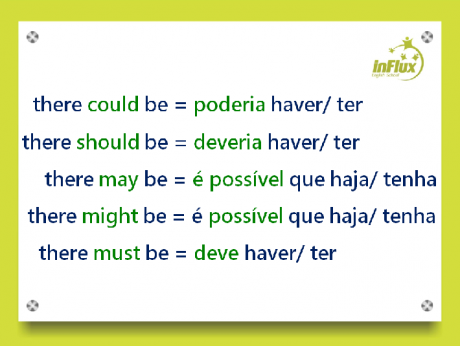
There be com modal verbs como might, could, may, should e must
Estrutura Ideia comum em português
there might be talvez haja / pode ser que haja
there may be pode haver / é possível que haja
there could be poderia haver / pode haver
there should be deveria haver
there must be deve haver

I’m not sure, but there might be another test by the end of the semester.

Não tenho certeza, mas talvez haja outra prova até o fim do semestre.


There could be more music in the show.

Poderia haver mais música no programa.


Do you believe there may be life on other planets?

Você acredita que possa haver vida em outros planetas?


There should be more trains during rush hour.

Deveria haver mais trens nos horários de pico.


He’s coming to work by bike. There must be something wrong with his car.

Ele está vindo trabalhar de bicicleta. Deve haver alguma coisa errada com o carro dele.

 
Exemplo visual de there must be em inglês

Resumo: como dizer “há”, “havia”, “haverá” e “haveria” em inglês?

Português Inglês
há / existe there is
há / existem there are
havia / houve there was / there were
haverá there will be
haveria there would be
talvez haja there might be
poderia haver there could be
deveria haver there should be
deve haver there must be

Como aprender essas estruturas sem traduzir palavra por palavra?

Em vez de tentar montar cada frase a partir do verbo português haver, vale memorizar as combinações completas.

Pense em there will be, there would be, there might be, there should be e there must be como blocos de linguagem.

É a mesma lógica dos chunks: você aprende a combinação que realmente aparece na comunicação, e não palavras isoladas.

Para revisar:
  1. Crie uma frase com there will be.
  2. Transforme a mesma ideia usando there would be.
  3. Faça uma previsão com there might be.
  4. Crie uma recomendação com there should be.
  5. Use there must be para fazer uma dedução.

Continue aprendendo inglês com chunks

CHUNKS
Estratégia de aprendizagem

O que são chunks e como eles aceleram o aprendizado?

Entenda por que aprender combinações completas ajuda a construir frases com mais naturalidade.

LEXICAL NOTEBOOK
Organização dos estudos

O que é e como usar um Lexical Notebook?

Organize estruturas, chunks, equivalências e exemplos para revisar em contexto.

Perguntas frequentes sobre there will be

Como dizer “haverá” em inglês?

Para dizer “haverá”, usamos there will be. Por exemplo: There will be a meeting tomorrow significa “Haverá uma reunião amanhã”.

O que significa “there will be”?

There will be pode significar “haverá”, “vai haver” ou indicar que alguma coisa existirá no futuro.

There will be serve para singular e plural?

Sim. No futuro, usamos there will be tanto com singular quanto com plural. Podemos dizer There will be a party e There will be many people.

Como dizer “haveria” em inglês?

Para dizer “haveria”, usamos there would be.

Como dizer “deveria haver” em inglês?

Uma combinação muito comum é there should be. Por exemplo: There should be more buses significa “Deveria haver mais ônibus”.

Como dizer “poderia haver” em inglês?

Podemos usar there could be. Dependendo do contexto, a combinação transmite a ideia de “poderia haver” ou “pode haver”.

O que significa “there might be”?

There might be indica possibilidade e pode equivaler a “talvez haja” ou “pode ser que haja”.

O que significa “there must be”?

There must be costuma ser usado para uma dedução forte. Pode equivaler a “deve haver”.

Qual é a diferença entre there is, there was e there will be?

There is fala do presente, there was fala do passado e there will be fala do futuro.

Mais futuro em menos tempo

Aprenda inglês por combinações que fazem sentido

Conheça os cursos da inFlux e veja como o método exclusivo com chunks trabalha vocabulário, estrutura, pronúncia e comunicação em situações reais.

Conhecer os cursos da inFlux


Você pode gostar de ler também

inglês para alugar um carro
28/09/2026

Frases úteis em inglês para alugar um carro

Alugar um carro durante uma viagem pode dar mais liberdade para conhecer novos lugares. Mas, na hora de fazer a

Leia mais...
collocations com a palavra time
26/09/2026

Collocations com a palavra “time” em inglês

Hoje, falar de tempo é algo bem comum. Seja falando de rotina, trabalho, estudos, viagens ou planos, precisamos ter tempo,

Leia mais...
to find out
24/09/2026

Como usar o phrasal verb “to find out” em inglês?

No post de hoje, vamos te mostrar como usar o phrasal verb “to find out” em inglês com exemplos do

Leia mais...
Evolua seu aprendizado com conteúdos gratuitos!

Cadastre-se e receba conteúdos que aceleram seu aprendizado de inglês e espanhol, com dicas práticas e materiais gratuitos para evoluir no idioma todos os dias.

logo inFlux

A inFlux é referência em curso de inglês e curso de espanhol no Brasil, com método exclusivo que acelera o aprendizado e leva você ao nível avançado mais rápido.

Instagram Facebook-f Youtube Linkedin Tiktok-logo tiktok
Institucional
  • Sobre
  • Garantia
  • Convênios
  • Trabalhe na inFlux
  • Fale com a Escola
  • Fale com a Franqueadora
  • Common European Framework
  • Experience
  • Política de Privacidade
A inFlux
  • Método
  • Cursos
  • Unidades
  • Notícias
  • Blog
  • Teste TOEIC®
  • Teste de Inglês Online
Cursos
  • Curso de Espanhol
  • Curso de Ingês
Franqueadora
  • inFlux Franchising
  • Av. Pres. Getúlio Vargas, 2635 - Água Verde, Curitiba - PR, 80240-040
  • (41) 3016-9898

©inFlux Todos os direitos reservados – METODO INFLUX IDIOMAS LTDA – CNPJ: 06.187.709/0001-24

Criação de Sites por Perspectiva Digital.

Peça uma demonstração de método

Peça uma demonstração de método

    Desculpe!
    Não encontramos nenhuma unidade inFlux nesta cidade ou bairro que você digitou.

    Converse no Whatsapp

    Preencha com seus dados abaixo e já vamos te colocar em contato com a :

      Você é aluno inFlux?


      Utilizamos cookies essenciais e tecnologias semelhantes de acordo com a nossa Política de Privacidade e, ao continuar navegando, você concorda com estas condições.
      Configurações de CookiesAceitar
      Manage consent
      Necessary
      Sempre ativado
      Necessary cookies are absolutely essential for the website to function properly. These cookies ensure basic functionalities and security features of the website, anonymously.
      CookieDuraçãoDescrição
      cookielawinfo-checkbox-analytics11 monthsThis cookie is set by GDPR Cookie Consent plugin. The cookie is used to store the user consent for the cookies in the category "Analytics".
      cookielawinfo-checkbox-functional11 monthsThe cookie is set by GDPR cookie consent to record the user consent for the cookies in the category "Functional".
      cookielawinfo-checkbox-necessary11 monthsThis cookie is set by GDPR Cookie Consent plugin. The cookies is used to store the user consent for the cookies in the category "Necessary".
      cookielawinfo-checkbox-others11 monthsThis cookie is set by GDPR Cookie Consent plugin. The cookie is used to store the user consent for the cookies in the category "Other.
      cookielawinfo-checkbox-performance11 monthsThis cookie is set by GDPR Cookie Consent plugin. The cookie is used to store the user consent for the cookies in the category "Performance".
      viewed_cookie_policy11 monthsThe cookie is set by the GDPR Cookie Consent plugin and is used to store whether or not user has consented to the use of cookies. It does not store any personal data.
      Functional
      Functional cookies help to perform certain functionalities like sharing the content of the website on social media platforms, collect feedbacks, and other third-party features.
      Performance
      Performance cookies are used to understand and analyze the key performance indexes of the website which helps in delivering a better user experience for the visitors.
      Analytics
      Analytical cookies are used to understand how visitors interact with the website. These cookies help provide information on metrics the number of visitors, bounce rate, traffic source, etc.
      Advertisement
      Advertisement cookies are used to provide visitors with relevant ads and marketing campaigns. These cookies track visitors across websites and collect information to provide customized ads.
      Others
      Other uncategorized cookies are those that are being analyzed and have not been classified into a category as yet.
      SALVAR E ACEITAR
      wpDiscuz